.png)

Boost Retention by up to 15%.
Provide Basic Needs Assurance.
Help Students Persist and Graduate.


Hear from Our Higher Education Partners and Customers
.png)
.png)
.png)
.png)
Students who receive support for basic needs are significantly more likely to stay enrolled.
Addressing financial instability can improve retention by up to 15.5%.

Single Stop Makes it Easy to Get Started. Download our step by step guide to learn more

Technology You Can Trust

Our benefits screener covers all 50 states - allowing partners nationwide to connect students to support they need.
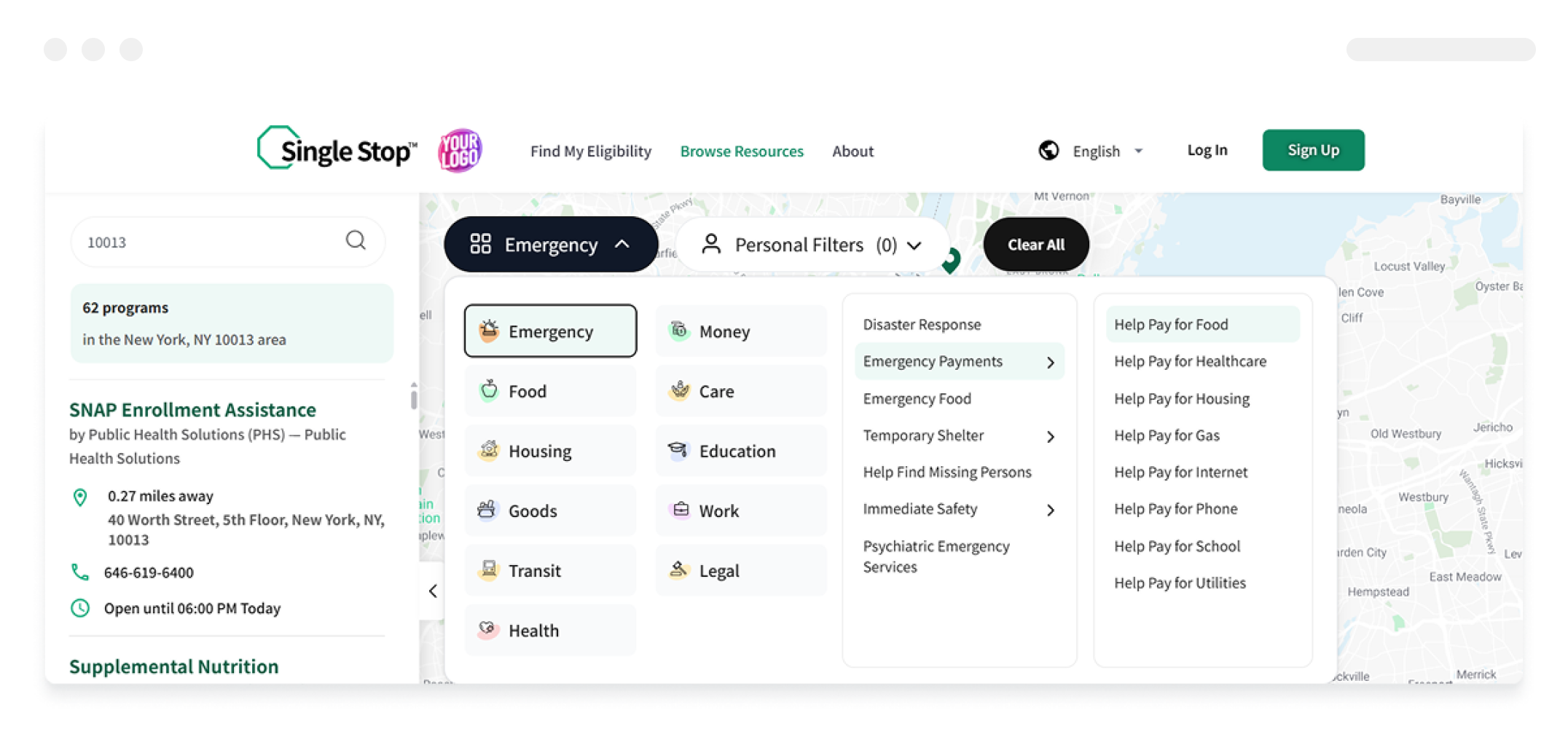
Provide a comprehensive response to students facing basic needs insecurity by connecting them to 20+ benefits, including food, housing, and health care.
Track impact and retention in real time with a measurable ROI. Students who receive basic needs support are up to 15.5% more likely to remain enrolled.
Source: Inside Higher Ed
Calculate Your Impact
Discover How Single Stop Supports Educational Partners
Frequently Asked Questions
Questions for colleges and universities evaluating our platform as student-success and basic-needs infrastructure.
Our platform gives institutions a centralized way to identify nonacademic barriers and connect students to public benefits, campus services, emergency support, and community resources. Students can screen privately on their own, while authorized staff can use the same platform to guide them, coordinate referrals, document follow-up, and track progress. We help institutions move from fragmented, reactive assistance to a proactive system of basic-needs assurance.
Financial strain, food insecurity, housing instability, transportation problems, childcare needs, and healthcare gaps can interrupt enrollment even when a student is academically capable. Our platform helps identify those barriers and connects students to resources that can stabilize their circumstances, helping institutions create the conditions in which students are better able to remain enrolled, complete coursework, and progress toward a credential.
Our customers’ results show that integrating our platform into campus basic-needs support can strengthen student persistence. At Community College of Philadelphia, students who received direct support through our program persisted at an 85% rate, compared with 72% among students who did not. At Pikes Peak State College, 70% of student survey respondents credited their interaction with us as a reason they were able to continue their education. These outcomes reflect the principle articulated by Southern New Hampshire University President Lisa Marsh Ryerson: “Every student deserves the opportunity to succeed, and that begins with ensuring they have what they need to survive and thrive.” Together, this evidence demonstrates how our platform helps institutions address the nonacademic barriers that can otherwise prevent students from remaining enrolled and completing their education. (CCP case study, Pikes Peak case study, SNHU evidence).
Our platform helps those services work as a connected system. A student who enters through a food pantry, advising office, financial-aid office, counseling center, or online link can be screened for a broader range of needs and directed to campus and community support. Staff can use our platform to reduce manual research, organize follow-up, and see whether students are moving from referral to action.
Both models are supported. Students can complete the screener privately from a phone, tablet, or computer, review potential eligibility, and follow application guidance. Colleges can also have trained staff complete or review screenings with students, assist with documents and applications, make referrals, and track outcomes. Across campuses, we see the strongest engagement when the technology is paired with visible outreach and readily available human support.
Depending on the student’s circumstances and the programs available, our platform may identify education-related support and consider qualifying education expenses when screening for other benefits. It can also direct students to campus emergency aid, transportation, childcare, housing, food, healthcare, and local services. Our platform complements the FAFSA and the institution’s financial-aid process by helping students identify additional forms of support.
Our platform can be linked from student portals, basic-needs pages, orientation materials, advising workflows, course communications, and outreach campaigns. Authorized staff can use role-based access for case management and reporting. During implementation, we work with the institution to complement its student information system, CRM, advising tools, food pantry, emergency aid, financial aid, and other campus services rather than create another isolated destination.
Our platform can report screenings completed, potential eligibility, benefit categories, referrals, case activity, application-related steps, and user-reported outcomes. Institutions can combine these measures with their own student data, where permitted, to evaluate persistence, credit accumulation, completion, and return on investment.
Strong implementations have visible leadership, a designated program owner, trained staff, repeated student outreach, and clear pathways from screening to assistance. Nash Community College embeds our platform in orientation, syllabi, workshops, and the Student Wellness Center. Tidewater Community College uses it as part of a multi-campus Student Resource and Empowerment Center. These examples show that our platform works best as infrastructure for a campus-wide support strategy, not simply as a link placed on a webpage.
Yes. Independent evaluations by RAND and Metis Associates have examined our work across multiple community colleges. RAND’s 2020 study found that use of our services was associated with an increase in student persistence of at least three percentage points and with more credits attempted. Results were particularly positive for adult learners, independent students, and students of color.
A multiyear Metis evaluation at Community College of Philadelphia used matched comparison groups and found statistically significant improvements in semester-to-semester persistence, degree-bearing credit completion, and GPA. Depending on the student group and time period, persistence was between 3.3 and 11 percentage points higher among students who used our services. The evaluation was designed to meet What Works Clearinghouse evidence standards with reservations. CCP’s own more recent outcome data corroborates these findings: students who received direct support through Single Stop persisted at an 85% rate, compared with 72% among students who did not.
RAND later conducted a randomized study across ten colleges, but very few students received the intended level of service: 12.7% completed the screener and only 0.9% engaged with a case manager. The study was conducted during the height of the COVID-19 pandemic, which consumed the capacity of college leadership and staff. RAND acknowledged the effect of the pandemic and concluded, “Despite our rigorous experimental design, we view the study take-up as insufficient to assess the efficacy of Single Stop supports.” The report provides valuable implementation lessons, emphasizing the importance of sustained outreach, staff capacity, leadership support, and deep integration into campus services.
Taken together, these independent studies and CCP’s continued results show the positive outcomes associated with a well-implemented Single Stop program—and reinforce the conditions institutions need to create for students to benefit fully from it.


.png)